


Plug in solar is now legal: what changed
Plug in solar panels became legal to buy and use across Great Britain on 27 August 2026, according to the government’s announcement. Until then, generating your own power meant owning a suitable roof, finding an installer and finding a few thousand pounds. Now a small kit can go on a balcony, a wall or a patch of garden and plug straight into a socket.
That is a real change for renters, flat owners and anyone whose roof faces the wrong way. It is also a new product, so there are checks to make before you hand over any money. Here is what plug in solar does, what it might save and what to sort first.
Northern Ireland is not included yet. The Energy Saving Trust says plug in solar panels are not currently permitted there, because the regulations still need updating.
What are plug in solar panels?
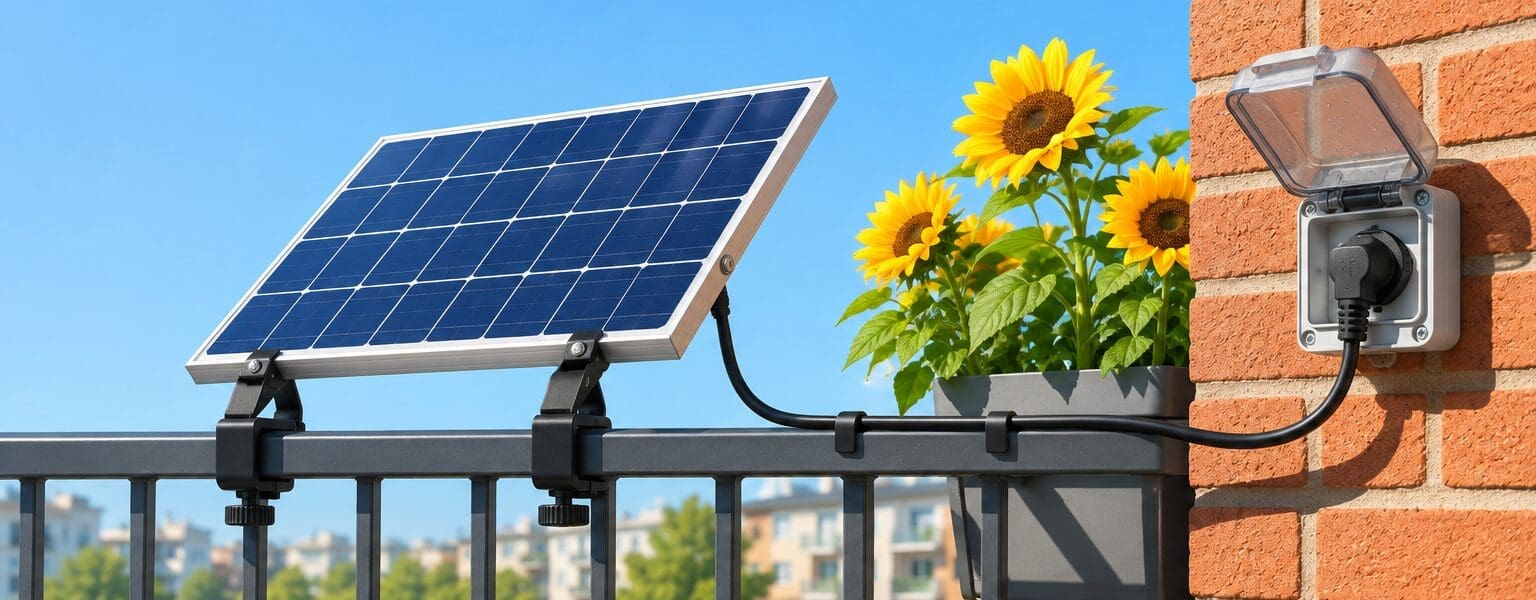
Plug in solar panels are small solar kits that connect to your home through an ordinary mains socket, rather than being wired in by an installer. You sometimes see them called balcony solar, because that is where a lot of them end up in Germany, where the government says around half a million new devices were plugged in last year.
The kit turns sunlight into electricity and feeds it into your home’s wiring. Your fridge, router or laptop uses that power first, so you draw less from the grid while the sun is out. When it is dark or cloudy, everything carries on running from the grid as normal.
There is a limit on how much power a kit can push into your home. The government’s product specification caps the power supplied to your mains installation at 800 volt amps, which the Energy Saving Trust puts more simply: 800W is the maximum amount of power allowed to enter your home’s electrical socket. The government says a kit of that size is enough to provide up to 20% of an average home’s electricity use, and gives the example of running a typical fridge, television, Wi-Fi router and laptop at the same time.
Note that the 800W limit is about what goes into the socket, not the size of the panels. The same specification allows total panel output of up to 2,000W, with the inverter keeping what reaches your wiring inside the limit.
How much could plug in solar save you?
The government’s own estimate is that plug in solar could save a household up to £110 a year on its bills. That is a ceiling, not a promise. What you actually save depends on your home: which way the panels face, how much shade they get, how much electricity you use during daylight hours and what you pay per unit on your tariff.
For comparison, the same announcement puts the saving homeowners can already make from rooftop solar at up to £480 a year. Plug in solar is the smaller, cheaper cousin, and it is priced and sized to match.
There is no official payback figure, and we would be wary of anyone quoting one as fact. Kit prices vary by retailer and model, so the sum is simple enough to do yourself: divide what the kit costs by a realistic yearly saving for your home. If the answer is longer than the panel’s warranty, think again.
The other half of the sum is the price you pay for every unit you still buy from the grid. Plug in solar trims that, it does not replace it. If you have been sitting on the same tariff for years, the quickest saving is probably on the bill itself, and doing nothing is the one option that never helps.
Checks to make before you buy plug in solar
The Energy Saving Trust’s checklist, written with the government, is clear on one point: do not buy plug in solar panels before getting the permissions you need. If you put panels up without them, you could be asked to take them down and pay for any damage.
Permission
If you rent, lease or live in a managed building, ask your landlord, freeholder or building manager first. Flat owners should read their lease for rules on fixing things to balconies, walls or railings. Depending on where you live, you may also need planning permission, and listed buildings and conservation areas have their own rules.
In England, a change to the permitted development rules in August 2026 made plug in solar easier to fit on houses. It comes with a catch worth knowing: the rules do not allow plug in solar to be installed on a wooden wall, or on a wooden fence or gate.
Your home and your electrics
Panels work best in an unshaded, south facing spot. East or west still works, just with less output, and north facing or shaded spots are not recommended. The kit must plug directly into a mains socket, with no extension leads, international adaptors or altered plugs, on a circuit that does not also control lighting or hardwired appliances such as a boiler or cooker.
Speak to a qualified electrician if your fuse box has older rewireable fuses, if you are unsure about your wiring, or if you need a new socket. An outdoor socket must be weatherproof and installed by a qualified electrician, and the Energy Saving Trust says a rating of at least IP65 means it is adequately protected against water and dust. Flats with external cladding or timber balconies need a word with the building manager first, because of fire safety.
The kit itself
Only buy a model that meets UK standards. The Energy Saving Trust says to look your model up on the ENA Connect Direct LCT Device Register before you pay. It is also worth telling your home insurer, and checking whether your policy covers things fixed outside.
Key takeaways
- Plug in solar has been legal across Great Britain since 27 August 2026. Northern Ireland is not included yet.
- Each kit is limited to 800W going into your socket, and the government estimates savings of up to £110 a year, depending on your home.
- Get permission from your landlord, freeholder or council before you buy.
- Plug straight into a suitable socket, never an extension lead, and register the device once it is up.
Setting it up and registering it
Follow the manufacturer’s instructions and fix the panels so they cannot move or blow over in strong wind. The Energy Saving Trust says not to fit them on wooden fences unless a professional has confirmed it is safe, which matches the permitted development rules in England, and to check a garage or shed roof can take the weight.
Only connect one plug in solar device per property, and do not link several kits together. Once it is running, test your circuit breaker protection every six months by pressing the test button on your consumer unit, if you have one. If it does not trip, unplug the kit and call an electrician.
Registering is not optional. The Energy Saving Trust says registering your plug in solar panels is a legal requirement, and it lets the network know about the extra power flowing into the system. Underneath it, the government’s rule is that you must register energy devices such as solar PV with your local distribution network operator. You register on the UK Plug-in Solar Registration website, and you will need your name, your postcode and the make and model of the device.
Is plug in solar right for your home?
Plug in solar suits homes that could never fit rooftop panels: renters, flat owners, and houses with a shaded or awkward roof, provided there is a sunny spot and the right permissions. It is less of a fit if you are away all day and use little power while the sun is up.
If you own a house with a good roof, rooftop solar is the bigger option, with a bigger possible saving and a bigger bill to match. Our guide to solar panel installation covers what that involves, and our guide to home battery storage explains whether a battery adds anything. If you already have rooftop panels, the Energy Saving Trust answers whether plug in solar can sit alongside them in its advice pages.
Roo’s view is that a sunny balcony doing nothing is a missed trick. Ours is a little more cautious: get the permissions sorted, buy a listed model, and treat the £110 as the best case rather than the plan.
Frequently asked questions about plug in solar
- Is plug in solar legal in the UK?
- Plug in solar has been legal to buy and use in England, Scotland and Wales since 27 August 2026. It is not currently permitted in Northern Ireland.
- Do I need an electrician to fit plug in solar panels?
- Not usually, as the kit plugs into a mains socket. You do need a qualified electrician for a new or outdoor socket, older rewireable fuses, or wiring you are unsure about. The 800W limit is on the power entering your socket. Separately, the Energy Saving Trust says to speak to an electrician if the panels themselves total more than 960W.
- Can I use plug in solar if I rent?
- Yes, if your landlord agrees. Get their permission before you buy, especially if you need to drill into walls or add an outdoor socket.
- Do I have to register plug in solar panels?
- Yes. The Energy Saving Trust says registration is a legal requirement. It is done on the UK Plug-in Solar Registration website with your name, postcode and the device’s make and model.
- How many plug in solar kits can I have?
- One device per property. Do not link several devices together.
Sources
- GOV.UK, Households can save as plug-in solar panels come to market, published 26 August 2026. Supports the 27 August legal date, the up to 20% of household electricity figure, the £110 and £480 savings and the German half a million devices figure.
- DESNZ, Plug-in Solar Device Interim Product Specification, version 2.0, July 2026. Supports the 800 volt amp limit on power supplied to the mains, the 2,000W panel limit and the 960W professional assessment point.
- Energy Saving Trust, Plug-in solar panel checklist. Supports the permissions, socket, circuit, IP65, device register, one device per property, six monthly circuit breaker test, wooden fence and registration points.
- Energy Saving Trust, Plug-in solar panels, last updated 2 September 2026. Supports the Northern Ireland position and the UK Plug-in Solar Registration website.
- The Town and Country Planning (General Permitted Development) (England) (Amendment) Order 2026, made 29 July 2026, in force 27 August 2026. Supports the England permitted development right and the wooden wall and wooden fence exclusions.
- GOV.UK, Register energy devices in homes or small businesses. Supports the requirement to register solar PV with your distribution network operator.
Checked 10 November 2026.


