

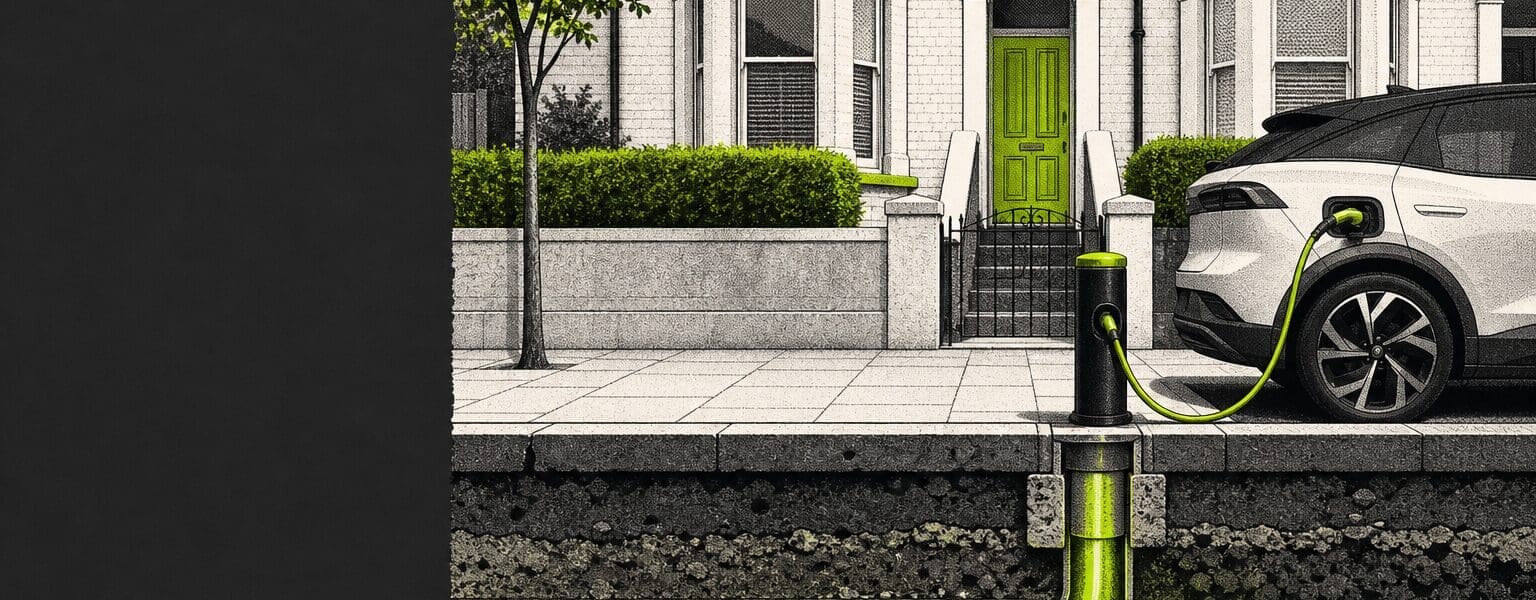

What is cross pavement charging, and what changed on 21 October?
Cross pavement charging is a way to charge an electric car at home when you have no driveway. A cable or channel runs from your house, under or across the pavement, to the car parked at the kerb. On 21 October 2026 the Department for Transport said drivers no longer need planning permission to install it.
Until now, these systems needed planning permission. That hurdle has gone. The government says it will take up to £300 off the cost of installation and open up home charging for as little as 2p per mile.
Those are the Department’s figures, not ours. What you actually pay will depend on your car, your tariff and your street.
The government’s guidance describes two main types of system. The most common is a cable channel set into the pavement, sometimes called a gully, which holds the cable while the car charges. The cable comes out again afterwards. The other is a permanent cable laid below the pavement, linked to the car by a removable bollard or similar connector.
The same announcement also says changes to permitted development rights will make it quicker and cheaper for charge point operators to install larger, higher powered public charging hubs. That is a separate point from cross pavement charging at your own front door.
Who still has to say yes to cross pavement charging?
Planning permission is the bit of cross pavement charging that has changed. The announcement says nothing about the council’s separate say over the public highway, and the government’s own guidance says the decision to allow a system on the public highway rests with the local authority. In plain terms, ask your council before you pay anyone.
The guidance also tells councils what to weigh up. They should be satisfied a system meets construction, safety and accessibility standards. They can look at the width of the pavement, the position of utility covers, and whether you can park outside your home at least once a week.
One point catches people out. The guidance says a cross pavement system gives you no ownership of, or priority for, the parking space outside your home. You could have the channel in the pavement and find someone else in your space. Worth knowing before you commission anything.
The guidance applies to England, so readers in Scotland, Wales and Northern Ireland should check the local position.
Before you commission cross pavement charging
- Ask your council whether it will allow a system on the public highway outside your home.
- Check you can park outside your home regularly, because the system does not reserve the space.
- Ask the installer how the system meets the council’s safety and accessibility standards.
- Get the full installation cost in writing, rather than relying on the headline saving.
- Look at your electricity tariff before you charge the first mile.
How much could cross pavement charging save?
The Department’s press release talks of savings of up to £1,750 on running costs for drivers who can use cheaper home electricity instead of public chargers. That is a best case for cross pavement charging, and the release does not show how it was worked out. Treat it as a ceiling, not a forecast for your street.
Your own number comes down to three things: how many miles you drive, what you pay per unit at home, and what you would otherwise pay at a public charger. Our guide to public EV charging costs shows what the pay as you go option can look like.
With cross pavement charging you are charging at home, so your tariff matters most. The Do Nothing Default does not care whether you drive an EV. A charger on a tariff you have never checked is still a charger on a tariff you have never checked.
If you already know which hours are cheapest, our time of use tariff guide covers when that pays off, and our EV energy tariff guide explains how tariffs built for charging work. Rates change, so check what is on offer when you decide.
What about renters and leaseholders?
Cross pavement charging matters most to people without a driveway, and plenty of them rent or live in flats. The government has opened two consultations aimed at that group and at new buildings. Both close on 16 December 2026.
One covers expanding EV charging access for tenants and leaseholders. The government says it could give landlords clearer guidance on handling requests, and it is considering mandatory requirements that make it harder for landlords and freeholders to refuse a renter’s application. The other covers building regulations, so that charge points go into new and refurbished covered car parks.
Both are proposals. Nothing in them has changed the rules for tenants yet, so the answer your landlord gives you today is the same as it was last week.
Vicky Edmonds, chief executive of EVA England, said in the government’s release: “It’s now up to local authorities and landlords to make these solutions easier to access in practice.” That is the gap to watch. A change to planning rules helps most when the council and the landlord are on board too.
Frequently asked questions about cross pavement charging
- Do I need planning permission for cross pavement charging now?
- Not for qualifying systems, according to the Department for Transport announcement of 21 October 2026. The announcement does not cover the council’s separate role over the public highway, so ask your council first.
- Is cross pavement charging available in Scotland, Wales and Northern Ireland?
- The government’s guidance on these systems applies to England. Check the position with your local council if you live elsewhere in the UK.
- Will cross pavement charging give me my own parking space?
- No. The government’s guidance says a system gives you no ownership of, or priority for, the space outside your home.
- Can my landlord say no to a home charger?
- Possibly, for now. The government is consulting until 16 December 2026 on rules that would make it harder for landlords and freeholders to refuse a tenant’s application. Nothing has changed yet, so ask in writing and keep the reply.
Sources
Department for Transport press release, Drivers to save up to £300 when installing EV chargers at home, 21 October 2026. Government guidance, Cross-pavement solutions for charging electric vehicles, published 24 December 2024. Energy Live News, Labour cuts red tape on cross-pavement EV charging, 22 October 2026.


